Split collar
A split ring-like concept for discussing how an assembled condition should be described. The gap, bore and fastening context matter together; an isolated product image cannot define their relationship.
Use this starting point ↗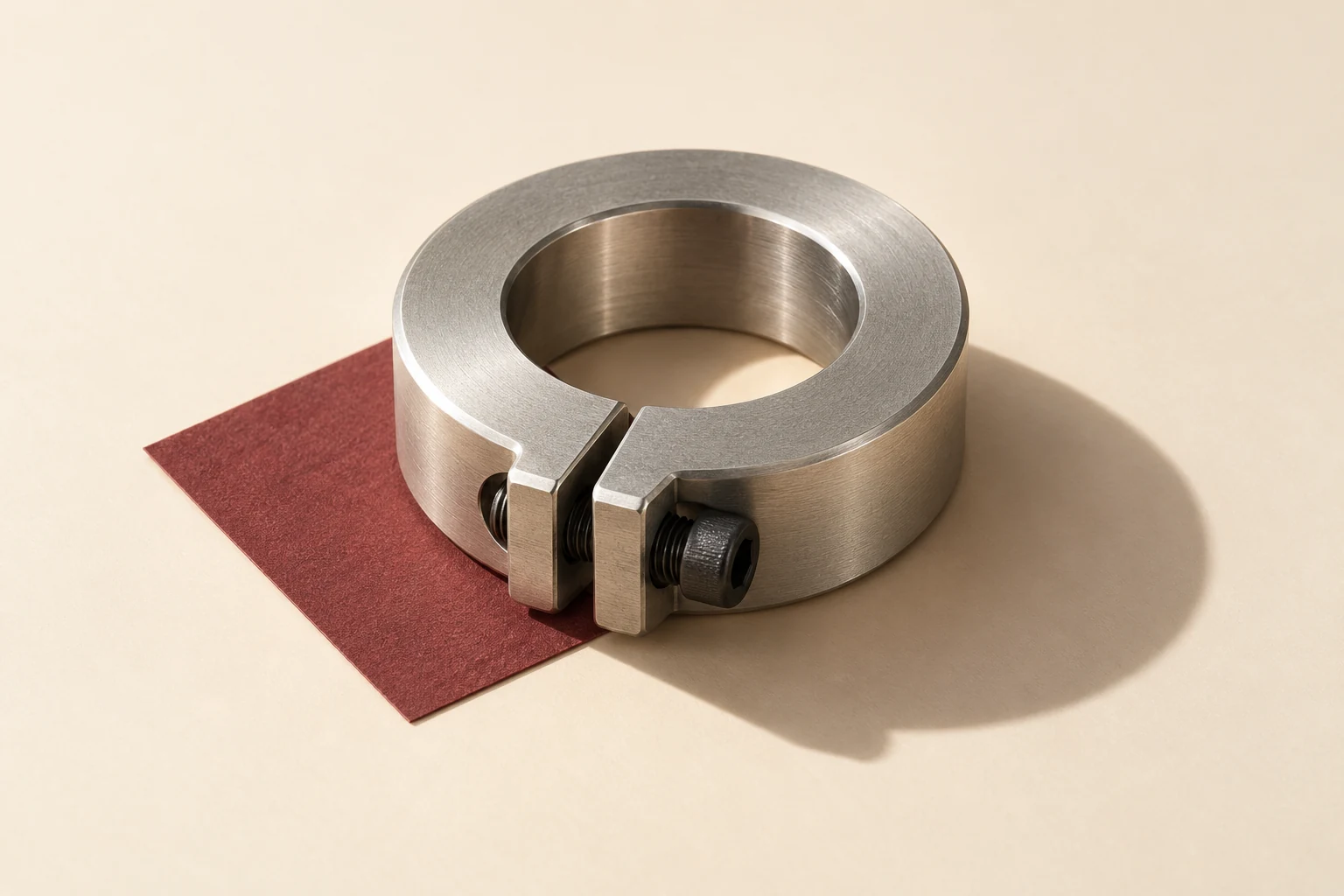
Read the intent first.
The split collar is a fictional interface study. It is useful when a buyer has a physical reference but the conditions of that reference are not clear. A free-state sample, an assembled sample and a drawing can express different information; do not silently treat them as interchangeable.
What defines the assembled condition, and how will that condition be reviewed?
Keep these decisions visible.
Clarify whether the discussion concerns the unassembled part, a specified assembly condition or an installed reference. Do not invent a force or torque.
Identify which companion part or interface is relevant. If that information is not available, keep the fit question open rather than choosing a tolerance.
A surface appearance sample may not be a dimensional master. Write down the sample purpose and who can resolve conflicts with the drawing.
What is the sample for?
Ask the sample owner to describe its assembly state and intended use in the review. If the sample was altered, used or obtained without a drawing history, record that limit alongside the sample reference.
Read the sample-review note ↗What evidence is needed?
Ask what condition should apply during inspection and how the report should describe it. Any fixture, method, sampling plan or acceptance criterion needs responsible review. This dossier supplies the questions, not an inspection specification.
Read the inspection-planning note ↗A useful handover contains…
- Drawing identifier and controlling revision
- Description of the relevant assembly condition
- Mating-part reference or an explicit unknown
- Sample purpose and known history
- Inspection-condition questions for agreement
Download the dossier as a plain-text discussion aid. It contains no production dimensions or acceptance limits.
Download this example dossier ↓Give the next conversation a clear starting point.
Collect the drawing reference, sample relationship and inspection questions in one local working packet.