Part
Hex standoffs
Threaded spacers turned from hex bar, counterbored at both ends. Bought in hundreds, so consistency across batches is the specification.
Open the part →TURNSTONEPrecision machining / demo
DEMO — fictional range. Local brief only, NOT SENT. No personal data is collected or transmitted.
PRECISION MACHINING / FICTIONAL RANGE
TURNSTONE is a fictional machining range covering threaded standoffs, grooved pulleys and slotted brackets. These are parts bought in quantity, so the site is organised around what happens across a run rather than around a single sample: which dimension moves first, and what a batch record has to show.
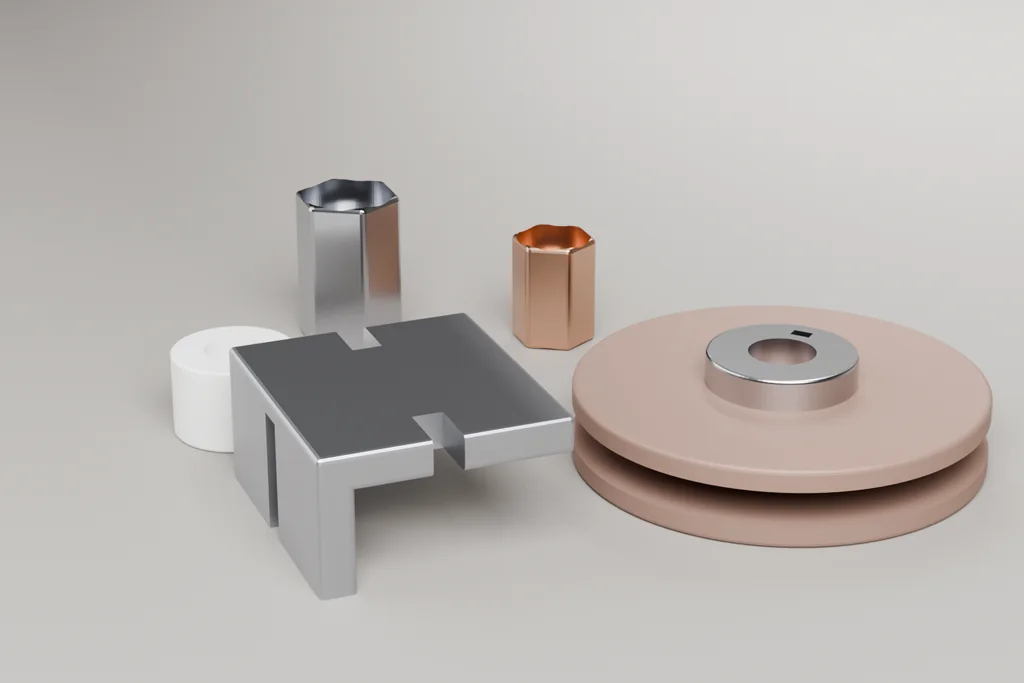
Each part in this range fails differently over a long run, and the dimension that moves first is different in each case.
Part
Threaded spacers turned from hex bar, counterbored at both ends. Bought in hundreds, so consistency across batches is the specification.
Open the part →Part
A single-groove pulley with a keyed bore and a pressed hub. The groove profile and the bore are turned in one setup.
Open the part →Part
An L bracket with slotted holes on both flanges. The slots exist so the part can be adjusted on site, which is also why position tolerance matters less than flatness.
Open the part →Four things that only appear across a run. A sample is made carefully, by hand if necessary, and none of them are visible in it.
Because it can be made slowly and checked individually. The question a buyer actually has is whether the run behaves the same way, and that is answered by a batch record rather than by a sample.
Whether a part will survive its real load. That is a physical property, established by measuring physical parts across a run.