Part
Turned shaft collar
A split collar turned from bar, bored and radially clamped. The bore and the clamp screw are the two features that decide whether it holds.
Open the part →KERNWELLPrecision machining / demo
DEMO — fictional range. Local brief only, NOT SENT. No personal data is collected or transmitted.
PRECISION MACHINING / FICTIONAL RANGE
KERNWELL is a fictional machining range covering turned collars, milled manifold blocks and precision flanges. Everything on this site exists to show how a machining brief is organised: what is decided before a drawing is issued, what a first article actually confirms, and what a quotation needs in order to be a quotation.
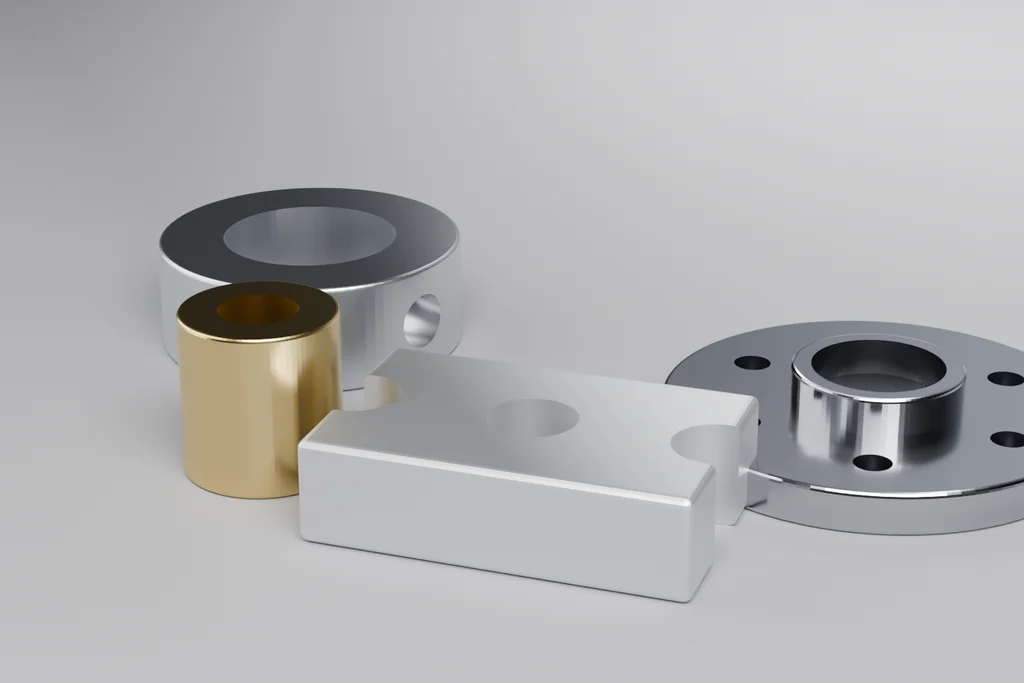
A collar, a block and a flange fail for different reasons, so the questions a buyer has to settle are different too. The range is small on purpose: each part carries one decision that the others do not.
Part
A split collar turned from bar, bored and radially clamped. The bore and the clamp screw are the two features that decide whether it holds.
Open the part →Part
A block milled from plate with a face pattern of bores and cross-drilled ports. Position between features is the whole specification.
Open the part →Part
A flange with a raised hub and a six-hole bolt circle, turned and drilled in one setup so the bore and the circle share a datum.
Open the part →Four decisions set everything downstream. They are cheap to change on a call and expensive to change after a first article.
It decides how tight everything else has to be, and it is the one thing a drawing usually arrives without. Two parts can share a material, a finish and a supplier and still need different tolerances because one is loaded and one is not.
Whether a part will survive its real load. That is a physical property, established by measuring a physical part against a written specification rather than by reading a page.