Describe the purchasing context and intended market to the responsible provider before asking it to review a product configuration.
This catalogue organises sample conversations; it does not choose a product for a clinical procedure. Identify whether the discussion concerns a garment outline, a sheet configuration or a wrapping-material reference. Let the appropriate provider and qualified reviewers determine the actual intended use and applicable product requirements.
Keep application questions in a distinct part of the brief. A request for a different opening, cuff, tie, layer or package can change the identity of the sample and the documents needed to evaluate it. Record the changed feature and ask for a new matching reference before treating earlier comments as current.
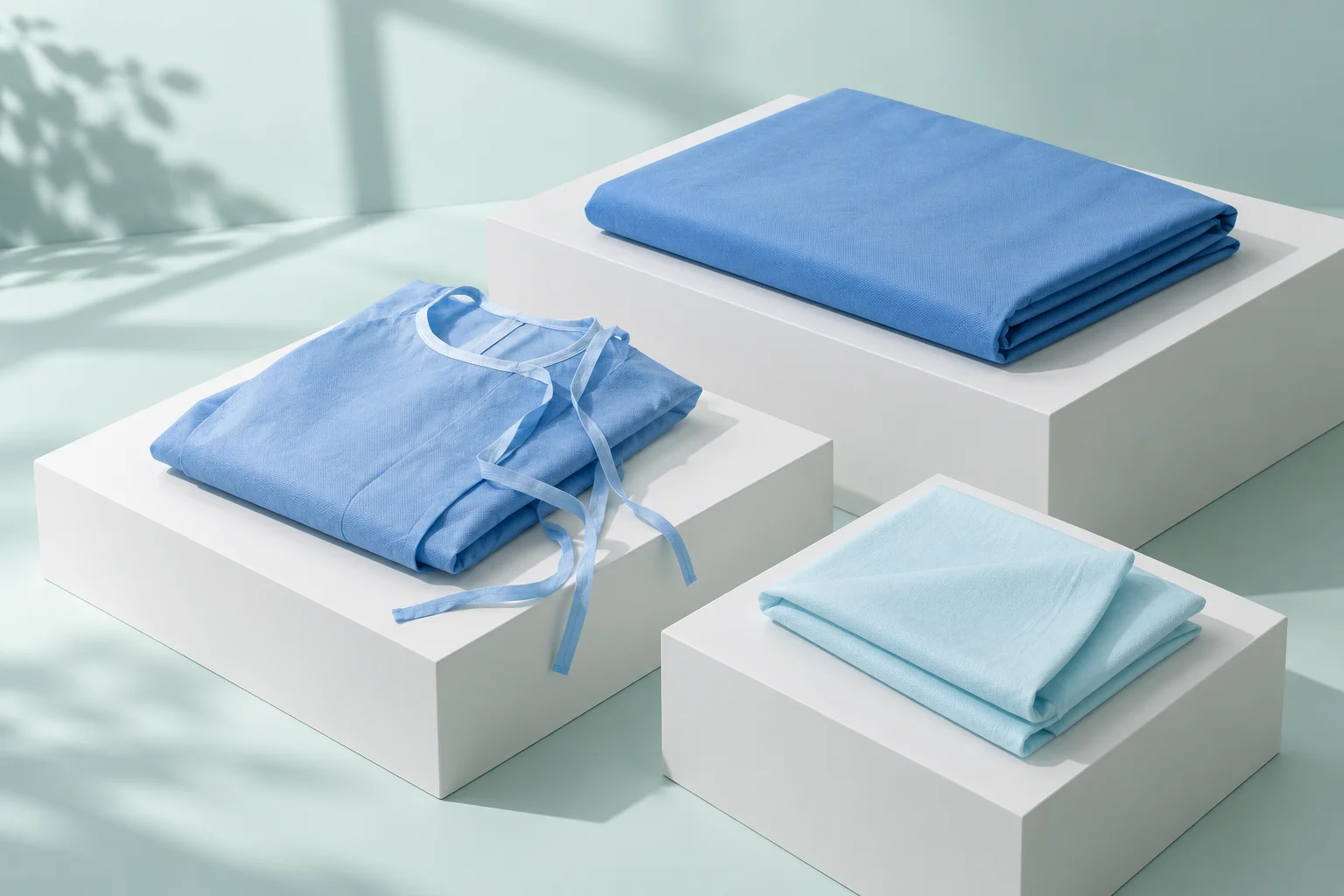
A light-blue nonwoven garment study with a visible sleeve fold and loose ties. Its dossier separates the garment outline, sample material and attachment detail so buyers can ask for the correct physical references.
Next question: Which drawing, material declaration and tie or seam sample identify the garment under discussion?
A broad rectangular nonwoven sheet shown with one corner unfolded. The plain geometry gives a buyer somewhere to start a conversation about the cut edge, orientation, actual dimensions and supply form.
Next question: Which actual cut outline, edge treatment and packaging reference belong to the proposed sheet?
A softly folded square nonwoven study that makes the visible face and layered edges easy to discuss. It is an appearance reference for a material and packaging conversation, rather than a represented sterile-barrier system.
Next question: Which material, face orientation and actual pack documentation identify the square-sheet sample?
A PRECISE NEXT DISCUSSION
Take the reference
with you.
Keep the object, pack or document question in a local record. It remains NOT SENT; no product, order, approval or clinical use is confirmed.