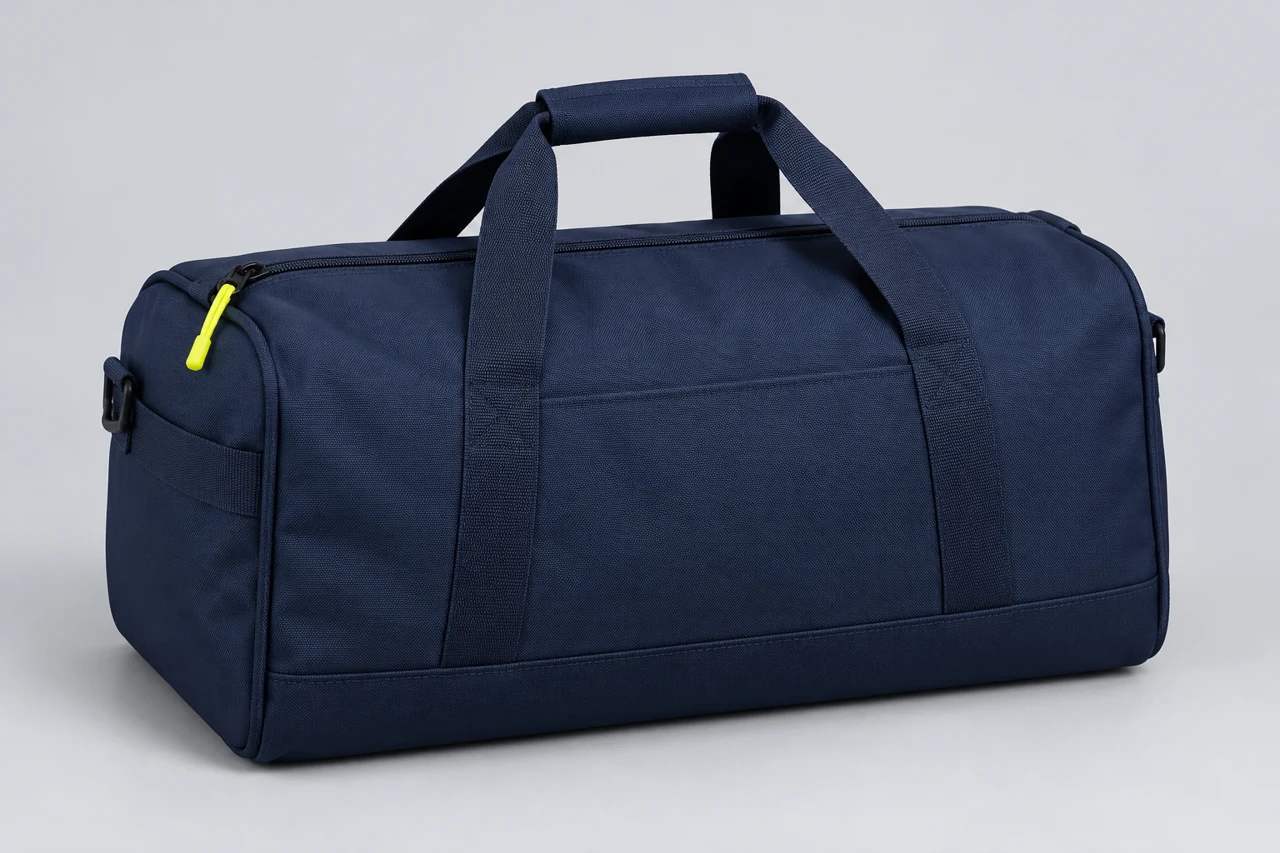
Transit duffel
One broad opening. A clear packing plan. A team equipment duffel concept built around the small things that slow down setup: mixed compartments, hidden labels and a bag that is awkward to count.
Start with the load list.
The SL–48 is the anchor of a shared kit. Use it for folded session bibs and the small, dry accessories your team already carries. A nominal litre value does not establish what actually fits. Send an itemized load list and compare a packed sample before agreeing the final size.
The proposed main opening keeps the contents visible from above. A separate flat organizer is reserved for paperwork or clean lightweight accessories. The ID sleeve offers a place for a buyer-supplied kit number; it is not a tracking device.
Choose a shell by sample, not a number.
600D and 900D identify two yarn-density directions in this concept. They do not prove abrasion performance, coating chemistry, carrying load or suitability for wet storage. Request swatches, coating disclosure and a seam sample, then compare the feel and packed weight against your own brief.
- Approve the handle length with the actual packed sample.
- Check that decoration does not cross a seam or interfere with the zipper.
- Specify whether the shoulder strap and ID sleeve are required on every unit.
What belongs in the first sample request.
Include the packing list, shell direction, intended carrying routine, decoration artwork and the buyer’s dimensional tolerance. Ask for a pre-production sample with all trims attached. Any load test method and acceptance limit must be agreed by the buyer and supplier; this demo makes no tested-load claim.
Review zipper travel, handle attachment, label legibility and carton arrangement as separate checkpoints. Record changes by sample revision so a color change does not accidentally reopen the approved pattern.