DEMO — fictional range. Local brief only, NOT SENT. No personal data is collected or transmitted.
PRODUCT / FICTIONAL EXAMPLE
Pin header
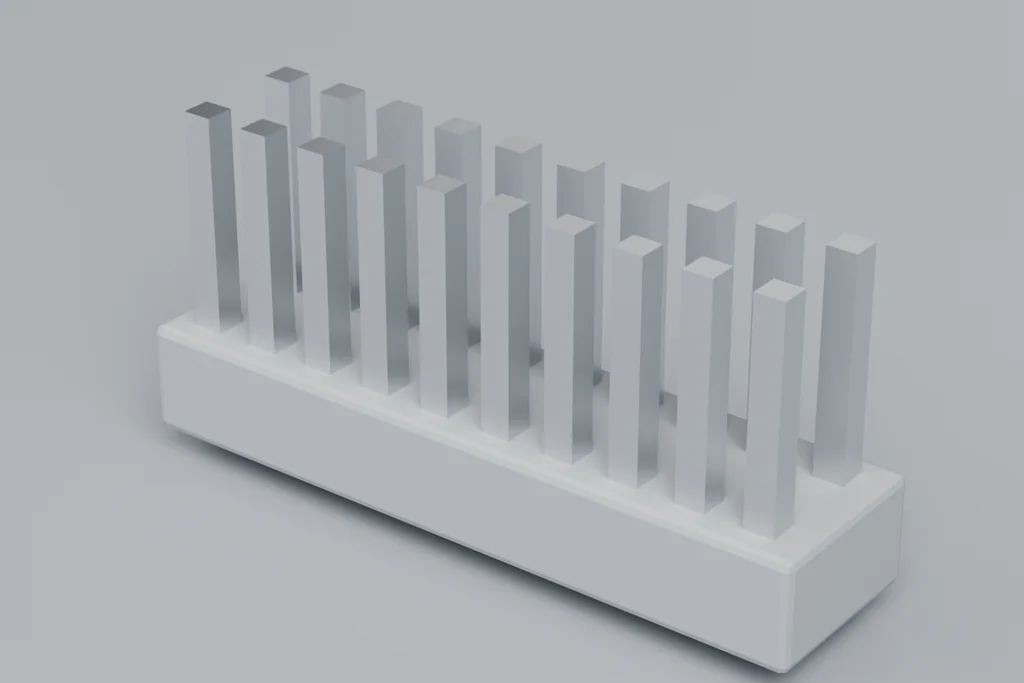
A two-row header with square pins in an insulator block. The pin is square rather than round because the mating socket is a tuning-fork contact.
How it is made.
The insulator is moulded and the pins are pressed in on a pitch. Square pins are used because a tuning-fork socket grips a flat face rather than a tangent, which makes the contact more repeatable.
Illustrative specification
- Ways
- Example · 2 × 10
- Pitch
- Example · 2.54 mm
- Pin
- Example · 0.64 mm square
- Mating cycles
- Example · 200
- Insulator
- Example · glass-filled PA
- Plating
- Example · tin over nickel
Every value above is an illustrative example for a fictional range. It is not a quotation, a capability statement or a measurement of any real product.
Why square pins rather than round.
Because the socket grips a face. A round pin contacts a fork along a line, and the position of that line depends on where the pin happens to sit; a square pin presents a flat surface, which makes the contact resistance more repeatable.
What the mating cycles cost.
The plating. A header mated repeatedly wears through a thin tin layer and the resistance rises, which is why a part expected to be re-mated is specified with gold.